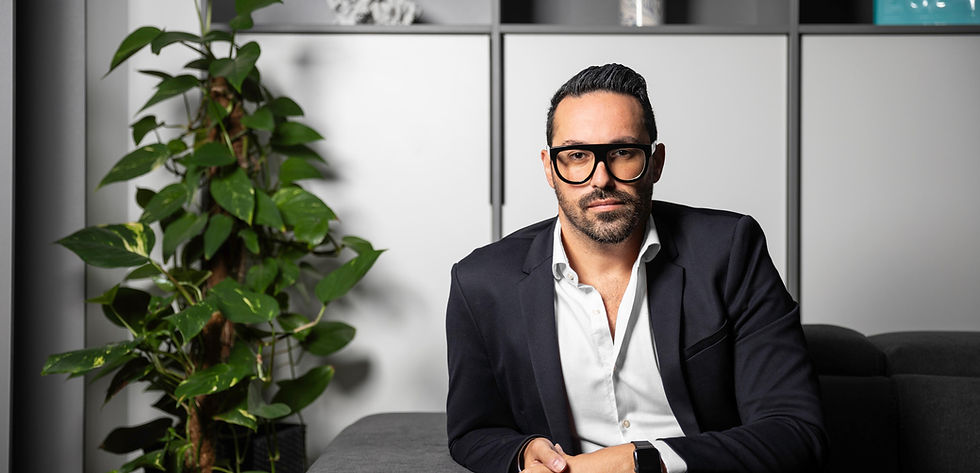
Justin Paul Anastasi
CEO, VentureMax Group
Justin Anastasi Justin Paul Anastasi is a Malta-based entrepreneur and business leader in the iGaming industry primarily known for his leadership in the iGaming, HR, and investment sectors.
Inspiring, visionary, adaptable, Justin Anastasi embodies the qualities iGaming needs. From humble beginnings, to recruitment and HR, creating his first business and now running one of Malta's most prestigious venture capital and private equity companies, Justin's journey has been nothing short of extraordinary.
iGaming Legacy:
Norm Challenger.
Raised the Standard.
Nurtured the Next Generation.
Philosophy:
I wanted to be what I wanted, but didn't have.
If the people you speak to, the people you work with and if the people they speak to all believe in the mission, then that's the secret sauce.
Career history:
VentureMax Group, OverPWR, Hireroo, WeConsultYou Ltd, Evolution Gaming, Pentasia, Avento Ltd.
Justin Paul Anastasi
iGaming History, Episode 1 Transcript
Narcis Gavrilescu: Good morning to everybody watching this. This is the first episode of iGaming History with a very special guest, Justin Anastasi, the CEO of VentureMax Group, without whom this would have never existed.
Justin, thank you because you found me almost ten years ago. We had the first fateful interview in October 2016, and you started my entire journey in the iGaming industry. I thank you for that. For anybody who doesn't know who you are, which would be quite surprising, can you tell us a bit about you?
Justin Paul Anastasi: Well, fair enough. Thank you, Narcis, for the lovely introduction. It's great to be here on your first podcast. It's an honor for me to be that number one. Very happy with that. I'm very happy to see where you have progressed in your career. I'm delighted to continue to be involved after all these years.
A little bit about me. I have been in the gaming industry over a decade. It's been quite a while. A journey, I would say. I started off working in recruitment back in my Evolution days, part of a very cool team which I also helped put together. That was super fun. Did that for a couple of years, moving ever since, growing from recruitment into HR. Got my first consultancy put together. Funnily enough, was my first exit as well.
Continued to build, moved into more strategy and advisory roles, and eventually landed me here as a CEO. A complete different view from being in HR to now leading a company that invests in the gaming industry. I've seen that evolution from the ground up: the people you meet and the different perspectives. In a nutshell, I've started from the bottom, now I'm here.
Narcis Gavrilescu: I give in, though, because I'm completely sure that whatever you would have put your mind to, whatever industry, you would have made it. What attracted you to this industry specifically?
Justin Paul Anastasi: In the beginning, it wasn't even the industry. It was the fact that it had all the ingredients that I liked. It was innovative. It was technology driven. The way in which it treated people was innovative for Malta, very different back then. A lot of these were smaller family-run companies. Gaming was at the forefront of a number of different things I was interested in at the time. It was the right place to be. I think it was also the right time. Although, I have to say at the time I went in, I also thought I was late. But as I started to experience more of the gaming industry, I understood that I made the right choice. It really encompassed everything that I wanted to be and do.
It was an industry bringing change or disrupting a space that wasn't as disrupted in the past. Adding responsible gaming layers, the compliance layers, but also bringing that entertainment value from land-based to online. Ultimately, I think it was a fluke, but it was interlinked to so many different things that I love and I still love to this day.
Narcis Gavrilescu: Do you think that it's still going to be a great industry to work in ten to twenty years from now? And if yes, why?
Justin Paul Anastasi: I think so. With gaming, you're always going to be challenged because things are changing all the time. As technology evolves globally, as does local politics and policy, things change all the time. There's a need to adapt and a need to build in order to thrive. I'm very curious about how the people aspect will evolve over time given what we're seeing in technology today. I'm very interested to see how the industry adjusts itself to that growing dynamic. But, I think it's 100% going to be. In fact, if you look at the history of iGaming, it's been around. How long has it been around?
Narcis Gavrilescu: Since '94. So that is thirty-one years?
Justin Paul Anastasi: However, yes. But also, people technically have been gambling for thousands of years. So not just gaming, but gambling as a game has been around for ages. That's not going anywhere.
Narcis Gavrilescu: I was thinking of writing about this. The first ever recorded gamble in history is actually three thousand years ago. They made the dice out of some bones. That was the first gamble.
Justin Paul Anastasi: There you go. People will do anything to gamble.
Narcis Gavrilescu: Yes. They will. How have you changed in the past decade? Or even how do you feel that the industry has changed you?
Justin Paul Anastasi: I've changed a lot. I came in, I wouldn't say naive, but when it's a new industry, you are kinda naive. You have all these big fantasies about what it is. In the beginning, I was struck with my immediate impact. Delivery was very important, and it was very important to me. That propelled my career and my growth very quickly because I was so eager to deliver. But then that same delivery, to your head, there was a time maybe when it got a little bit to my head, that I could do absolutely everything.
I still believe I can do anything, but the delivery aspect almost made things that were completely impossible seem possible at the time. I learned over time to become a little bit more humble, a little bit more realistic. Overall, the gaming industry taught me to be very disciplined, contrary to my natural energy. I like to do a lot, and I spread myself very thin sometimes, but I've learned to be very disciplined, a lot more structured. I was never someone who would use email. So for me, being very structured in my calendar, my time, my days, and maximizing what I can do, I learned primarily through gaming.
Narcis Gavrilescu: To add to what you said, that you feel that you could do everything, this is one of the things that I found very inspiring about you. There is a famous quote, "act as if you have no limits to your abilities." You were the first person that I've seen who actually lives up to this. So I found it quite inspiring. You still have it. Had you ever not joined iGaming? Have you ever played out in your mind how things would have worked out?
Justin Paul Anastasi: It's an interesting question. I have thought of alternative realities of what else could I have done. But I've never really given it too much thought. If I wasn't in gaming, I'd still be an entrepreneur. I think that was always something I was destined to do. If it wasn't in gaming, it would have been in the digital space.
As a young man, I was always thinking about different things online that I could do. Prior to gaming, I had worked for Property Finder, which is now Zoopla. I love property. So I probably would have ended up being someone who did what I'm doing today as well: buying old properties and restoring them. Or I would have been in politics. I probably would have done something online. But I would have 100% done something in business.
Narcis Gavrilescu: Only because you touched the element of politics. You are quite active online. You talk about things that are to the interest of the Maltese public. Can you tell us about the motivation behind that?
Justin Paul Anastasi: I think everything is very interconnected. I talk a lot about CSR as well. We also do that in all of my companies. That's primarily driven by my belief that as an entrepreneur, as someone who is succeeding, your environment has contributed to enabling that success. I think you need to give back. For me, that's what's important. You're contributing to society. So even when it comes to opinions or things going on politically, anything that affects how business is conducted, what could be better. A lot of people tend to avoid discussing an issue or expressing an opinion. But we need to have discussions. We do this in business.
I tell my teams it's very important that you have an honest and open dialogue. That doesn't mean you're not gonna get challenged. I challenge a lot of people on their opinions. If they can win that argument with fact, then I will say, what actually makes perfect sense? So I think that's where I'm coming from. It's important to contribute.
Narcis Gavrilescu: Mhmm. Alright. Coming back to how businesses are run. Over the last decade, what do you think have been the most impactful regulations or technology changes? What has changed the trajectory of the industry?
Justin Paul Anastasi: Interesting. Of course, the obvious most recently. But I'll try and go back to reflect a little bit. I think probably GDPR has by far had an impact. It's forced disciplines on how we digest and deal with data. I think we necessarily were thinking about that before. There's also been a lot of restrictions on advertising and how you get to your player. I think that has been restricting because the more you restrict, the more you give birth to loopholes. I don't agree with sweepstakes, for example, but I think they have been born of these same issues. The advertising restrictions, particularly in the EU and the UK. Although we've seen similar things in Sweden, Australia. A number of different countries.
Narcis Gavrilescu: Finland. I think they're doing something with the advertisements as well. This is probably a good subject to study. From what I've seen, the industry has a recurring theme. First, some offshore legislations are born, then local regulators want to make things more stable. So people flock from offshore to locally regulated, but then the locally regulated sometimes gets too regulated, causing people to go offshore again. This is the trends that I've seen.
Justin Paul Anastasi: Yeah. I would agree. On top of that is, of course, the pandemic. AI, these instant crash games. All the different things that have been going on. What I've noticed is that there is a lack of time spent on what comes next. The industry is still quite reactive. We react to what other people do, what policymakers do, what makes news. I think we need to avoid that and start planning ahead. If we start to think of the long term and work more with policymakers, we'll end up with something better that we can plan more long term, be less reactive.
Narcis Gavrilescu: Mhmm. Speaking of– you mentioned AI just a second ago. One year ago, I saw interviews with you saying that AI, Blockchain, and AR/VR are interesting technologies that will reshape the industry. Do you feel the same now, one year later, or has anything changed?
Justin Paul Anastasi: I wouldn't say anything has changed. On some of those, things have been expedited. They've accelerated. AI is obviously truer than it ever was. We're seeing it pour in. I kinda try and avoid mentioning it today because before you had to talk about it because it wasn't well known. But today, it's part and parcel with what we do.
AI today is in fraud detections, in RG, in the monitoring. It's helping to create content, create games, define odds. It's helping to do everything. And as a result, that's having knock-on effects. That's why I was saying earlier I'm curious to see how these innovations interact with the people side of the business. Blockchain is still a provenly fair system. Especially in specific markets, it can still work very well. It is becoming– people are sticking their claws into it, which is gonna make it less useful. AR is not really discussed a lot. AR is probably going to evolve more, but I would imagine that being more twenty years down the line before people start to utilize that more.
Narcis Gavrilescu: I wanted to ask you about this. VR and AR have been used extensively as keywords, a bit as hype keywords. I haven't seen too much adoption. I think it will be very driven by one of the FAANG companies probably launching AR glasses, a stable, easy-to-use product.
Justin Paul Anastasi: Yeah. I would agree.
Narcis Gavrilescu: Yeah. Alright. You are extremely gifted with people. Extremely gifted is an understatement. You are still the only manager that I've had in thirteen years who sat down with me on a Saturday morning to teach me how to hit my targets. I remember I told you, I don't think I'm gonna make this one. I tried everything that I know. It just doesn't work out. And on a Saturday morning, you spent an hour with me. You showed me, and it worked. I have used that ever since. How did you cultivate this leadership style?
Justin Paul Anastasi: I think it probably came from the lack of having that leadership style myself. It's interesting. When I was younger, I always had this thing for refusing to want to blend in and be the same as everyone else. I always made it a point to stand up, but in standing up, I never had anyone to look up to. As I started my working life, I never really had that. I went in always thinking that I was an outsider. And that was always tough. So I had to self-soothe, self-teach, and self-mentor myself. I didn't really have any of that. I've never really had that. I made the decision that I wanted to be what I wanted but didn't have. I think that was important.
Narcis Gavrilescu: That should be framed and go up on the wall. Very profound. One of the other questions was, did you ever have a mentor? But I think you answered. Is there somebody that you ever looked up to as a good example?
Justin Paul Anastasi: I tell you what, I'm a little bit allergic to the mentor. When you focus in on a mentor, you are focusing in on one person. I don't have a mentor nor have I ever had one, but do I learn from the people around me? Yes. My trick has been to not focus on one person, but to learn from everyone. It's important to learn from everyone. I don't mean learning from people above you or on the same level. You can learn from everyone.
So long as you keep the willingness and the humbleness to say, I'm always ready to learn. I've learned from people that used to be in my team. I see them today, where they've all grown. A friend of ours told me recently about some games and how to integrate them. Now previously, he was at Evolution. So look at how things go. For me, don't focus in on one person because that limits you. Focus on learning something from everyone you're around, but then choose the people you surround yourself with. You have to be selective about who you expose yourself to, especially if your priority is to grow.
Narcis Gavrilescu: Alright. One other thing about managing people. I'm not sure everybody knows, but you stand up for your people in board meetings. To me, at the time, I was shocked, but pleasantly shocked. You never talk about it. Where does that come from?
Justin Paul Anastasi: Again, I think it's because I didn't feel that I used to get defended. When I first started at school, it was tough. In work, in the beginning, I didn't really have that. I learned a lot of what not to do in my early years. The difference with me is that I never forget it. I still remember that kid. I still remember that young man. And I know that everyone else goes through the same thing. For me, having younger people around me– today I surround myself with older, more experienced people– but for me, it's important. To this day, I still defend them when I believe they're right.
If they're incorrect, I will have a different conversation separately. For me, it's important for them to know that as a leader, there is a price that you pay for leadership. That's not to throw something negative onto your team. It is to bite the bullet. Stay on your responsibility. I firmly believe that if something goes wrong, it's your responsibility. Your job is to take it as a learning experience, then help them get beyond that. If you're leading, it is your job to be responsible for your team, and that does mean you have to take the bullets before them.
Narcis Gavrilescu: This ties in very well to the next question. The industry has young people who find success almost immediately. What would you recommend to entrepreneurs coming into the industry? How should they look at it?
Justin Paul Anastasi: It depends what you're trying to do. The world of gaming has changed a lot. A lot are looking for that quick buck. They will try to come up with something loosely regulated. I know a lot of people that started a casino. They didn't have the right financial backing. Someone won a bonus day one, and they were done. I've seen a lot of them close like this. They have big dreams and they just don't plan. There is an element of luck involved, but when it comes to your future, you can't rely on luck. You have to plan for success. If you're gonna be an entrepreneur, especially in gaming where the risks are high, you need to plan it well and give yourself honesty.
Is this really solving something? Is this really needed, or am I just doing the same thing? If you are doing the same thing, it's probably not worth pursuing. Not to say companies that copy don't make money. But to do that, you have to have real money behind you. The easiest way for an entrepreneur is to solve a problem and come up with something people actually need. If you're going into the working world, give yourself the time to learn. Understand the industry as a whole and understand where you want to fit in.
Narcis Gavrilescu: What you said, "does this really solve a problem?"– I've seen it a lot in payments. In a world where everybody does the same thing, you can't stand out. I've seen businesses fail. This is relevant. In the lines of investments, you are in a position where you look at the market. What are some interesting opportunities that you see or things VentureMax would be interested to see evolve?
Justin Paul Anastasi: We've probably seen 300 plus different decks. We've got three in final stages, but one that we've invested in. The ratio is low. A big part is the mix is wrong. The idea has already been done. There's nothing unique. Or the entrepreneur isn't hungry or motivated. But where we are today, there is definitely an interest in someone who can crack the AR space. I would be excited to see someone who really cracks it. Something as engaging as being in a land-based casino.
Narcis Gavrilescu: AR? Okay.
Justin Paul Anastasi: I would be that would be interesting. Anyone who can really well automate things like customer support, RG, AML, advertising. Anyone who can really do that well. We've seen chat bots, but having real voice calling with different AI agents, that's gonna be cool. Content, but really good content, that's still key. Maybe not vast volume, but more quality content. Anything to do with the data space is important. Data is king, and it's undervalued. The raw material for gaming is data. It's not money. If you find a way to gather the right data from your own customer base, that would be interesting.
Narcis Gavrilescu: Alright. These would be subjects for other conversations. I have a list of quotes I collected from you over the years. I would mention them and like you to give your opinion. First, "It's not only about working with people, but also working through people." Comments? How do you view it?
Justin Paul Anastasi: 100% still relevant. No man is an island. You can only do a lot by having solid, talented people who believe in what they are doing. "Through people" means if the people around you, your team, the people they speak to, all believe in the vision, then that's the secret sauce. You can do so much more when you have that ripple effect. Your team being able to act in a way that is in line with that same vision helps expand your reach and ability to build momentum. For me, it's important that is understood as genuinely believing. That can be misinterpreted as "we'll just tell them what to do." That is not the secret sauce. People need to believe in it. To believe in it, they need to spend time with you. They need to understand what they're trying to create. They need to embody it. Only through you can they get that. And that means you have to invest your time with each one of them.
Narcis Gavrilescu: Mhmm. To me, the "why" is very important and also being able to ask it without burden.
Justin Paul Anastasi: I always challenge the norm. I always challenge the assumption. So that comes with "why." If you don't ask why, you're not doing that. Through challenging, you can understand how something has gotten to where it is. I've done that for a very long time. That interlinks to understanding problems and how to solve them. I would never have been able to solve problems without having understood the why. How it got there. So why comes to solving issues. Why is important to learning. When I was learning who I did not want to become, I did that by asking myself, why is someone like that? Why are they thinking like that? Why did they do that? These things are still important.
Narcis Gavrilescu: Reflection is key.
"I believe we have a limited amount of time here, and we have to do the most we can with this time."
I'd like you to tell us how you came to this conclusion.
Justin Paul Anastasi: I have always valued my elders. I value their experience. I valued what my grandparents went through in the wars, the stories they told me. I always understood that I'm here for a limited period of time. When you know that, you wanna maximize that time as much as possible. For me, it's become a currency. I haven't got the time, aka the money, to invest that time in something I don't want to do because I'm gonna lose it. I'm not gonna get it back.
It's not like I dropped €10 and I'll make another 10 tomorrow. I'm not gonna get it back. That has dictated what I choose to spend my time on. Do I wanna go out and get completely rat-arsed? Do I want to have a boring conversation with someone who has nothing to teach me? Do I wanna spend time with people I don't enjoy? Do I wanna spend time pretending? Today, the answer is no. I want to make the most of the time that I have because it's limited. I want to impact the most I possibly can on the planet and on the people around me.
Narcis Gavrilescu: Very good. The final question, how would you like to be remembered in iGaming history?
Justin Paul Anastasi: I would want to be remembered as someone who challenged the norm, who challenged the status quo, but also who raised the bar and nurtured the next generation. People who spent time with me, who were in my teams, like yourself, who have given their own valuable contribution to the industry and their community. I would like to be remembered for helping build that next generation of this industry in Malta. You've gotten married. You're having a child. This is all happening in Malta. So it's nice to be remembered for those things.
Narcis Gavrilescu: From my perspective, this legacy will always exist. Your legacy will always exist. I'm sure there are hundreds, probably thousands of people out there who feel the same.
Justin Paul Anastasi: Very sweet.
Narcis Gavrilescu: I am convinced that this legacy will endure. Thank you very much, Justin, for joining us and for this insightful conversation. Thank you to everybody who is watching. You will hear from us very soon.
Justin Paul Anastasi: Fantastic. Thank you very much for having me, and good luck on the podcast and iGaming History.
Narcis Gavrilescu: Thank you very much, Justin.
Let us build your legend
Your place in iGaming History awaits. Get in touch.


